


Phone:
0086-0769-82767811
0086-13929200954

Views: 0 Author: Site Editor Publish Time: 2026-01-09 Origin: Site


As protective standards continue to evolve, helmet safety is no longer defined by simple linear impact resistance. Today, manufacturers, certification bodies, and research laboratories are facing a new reality: real-world impacts are complex, multi-directional, and unpredictable.
This shift has fundamentally changed the role of the helmet testing machine in product development and compliance.
For brands aiming to meet modern safety expectations—and exceed them—investing in advanced helmet testing equipment is no longer optional. It is essential.
Traditional helmet testing focused primarily on linear impacts, measuring how well a helmet absorbed vertical forces during a straight drop. While this approach laid the foundation for safety standards, it failed to fully represent how injuries occur in real accidents.
Recent research has shown that rotational acceleration and oblique impacts play a major role in traumatic brain injuries. This understanding has driven the development of new technologies such as MIPS (Multi-directional Impact Protection System) and has raised the bar for helmet performance worldwide.
As a result, modern safety standards increasingly require testing methods that can simulate:
Angular and off-axis impacts
Combined linear and rotational forces
Variable impact velocities and surface conditions
These demands place new technical requirements on the helmet testing machine itself.
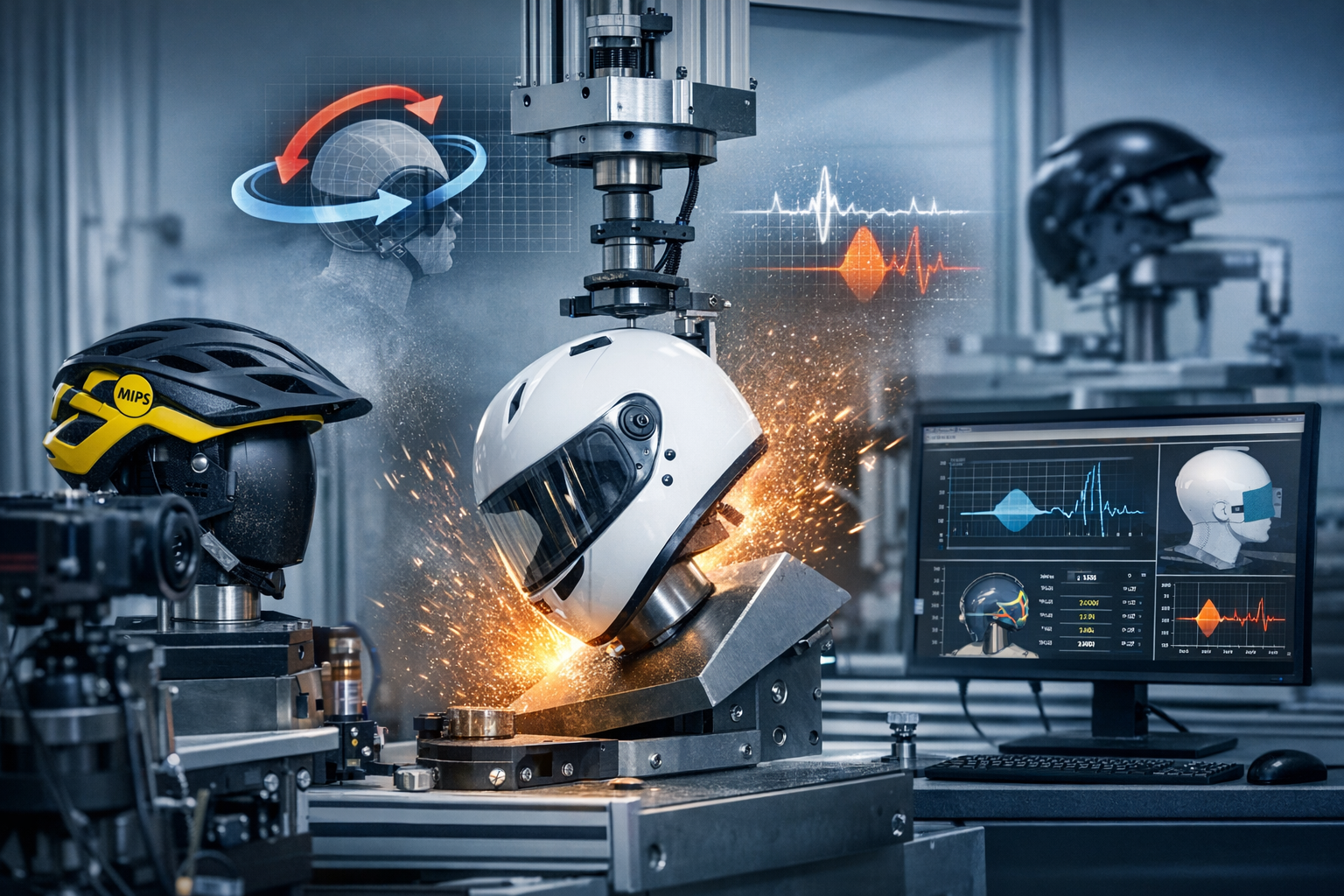
MIPS technology introduced a low-friction layer inside the helmet designed to reduce rotational motion transferred to the brain during angled impacts. While MIPS has become widely recognized, its real impact lies in how it reshaped testing expectations.
To properly evaluate helmets with rotational protection systems, manufacturers must rely on helmet testing machines
capable of measuring both linear and rotational kinematics. Without this capability, it is impossible to verify whether a helmet truly performs as intended under real-world conditions.
In short,advanced helmet designs require equally advanced testing solutions.

A next-generation helmet testing machine should do more than meet basic compliance requirements. It should support product innovation, quality control, and global certification. Key capabilities include:
Modern systems must replicate angled and oblique impacts, allowing realistic assessment of rotational forces.
Accurate data collection for acceleration, force, and energy absorption is critical for reliable test results.
Flexible control over drop height, impact velocity, anvil type, and helmet positioning enables testing across multiple standards and use cases.
Consistent test results are essential for R&D validation and third-party certification.
A professional helmet testing machine is not just a compliance tool—it is a strategic asset for manufacturers competing in a safety-driven market.
Investing in modern helmet testing equipment delivers measurable business advantages:
Faster product development cycles through accurate, repeatable testing
Reduced certification risk by aligning with evolving international standards
Improved product credibility in premium and professional markets
Greater trust from consumers, regulators, and partners
As helmet safety becomes a key differentiator, testing capability directly influences brand reputation.
Not all testing machines are created equal. When selecting equipment, manufacturers should work with suppliers who understand bothtesting standards and real production challenges.
At Great Win, we specialize in designing and manufacturing advanced testing solutions for protective equipment. Our helmet testing machines are engineered to support modern impact simulation requirements, helping customers evaluate complex impact behavior with confidence.
By combining precise mechanical design, reliable data acquisition, and user-friendly operation, Great Win provides testing equipment that supports both compliance and innovation.
Helmet safety is moving beyond minimum requirements. Brands that succeed in the next generation of protective equipment will be those that understand real-world risks—and have the tools to test for them.
A modern helmet testing machine is no longer just about passing standards.It is about proving performance, protecting users, and building long-term trust.
If you are looking to upgrade your helmet testing capabilities or explore advanced impact simulation solutions, Great Win is ready to support your testing needs.
Contact us today to learn more about our helmet testing machines and how they can support your product development and certification goals.


